The Wayfinder
Navigate Travel Like an Expert
Travel has changed fast in recent years, from the pandemic pause to the boom in “revenge travel” and today’s added uncertainty. But people are still making trips a priority. Instead of traveling less, many are planning earlier, taking bigger trips, and often following the lead of retirees.
To see where travel is heading in 2027, we analyzed a year of Seven Corners Trip Protection and Travel Medical policy data, compared 2026 with 2025, and reviewed traveler feedback, concerns, and top questions.
Trips costing $10,000 or more made up 28% more of our Trip Protection policies in 2026 than in 2025, rising from 4.2% to 5.3% of all policies. Trips over $5,000 grew from 8.3% to 10.2% of policies, and every price range above $5,000 gained ground.
Our agents heard the same thing on the phone. Bucket-list and once-in-a-lifetime trips were among the most common trip types all year, along with anniversaries, weddings, and milestone celebrations. Some travelers were dreaming even bigger: world cruises lasting 180 days or more, luxury cruises topping $100,000 per person, and plans to live abroad for a year or longer.
Big splurges are growing, but most travelers are still value-conscious. About 9 in 10 Trip Protection policies in 2026 were for trips costing $5,000 or less.
What's changing is where travelers choose to spend. Experience-led travel came up again and again in conversations with our agents: safaris, gorilla trekking, milestone anniversaries, and multigenerational trips where grandparents often pick up the tab. Travelers seem willing to save on some trips so they can invest in the ones that matter most.
For value-conscious travel, close-to-home destinations stand out in our data. More than 9 in 10 policies for trips to Mexico, Canada, and within the U.S. were for trips costing $5,000 or less.
If you're planning trips for 2027, decide which trip is your "big one" for, and plan short, budget-friendly getaways around it. For the big one, protecting your investment early matters more.
Italy is our top international destination, ranking #1 for Travel Medical and #2 for Trip Protection, behind only trips within the United States.
| Rank | Travel Medical | Trip Protection |
|---|---|---|
| 1 | Italy | United States |
| 2 | France | Italy |
| 3 | Mexico | Mexico |
| 4 | United Kingdom | United Kingdom |
| 5 | Spain | France |
| 6 | Japan | Spain |
| 7 | Germany | Japan |
| 8 | Canada | Canada |
| 9 | Switzerland | Germany |
| 10 | Netherlands | Greece |
Europe still dominates, and the list barely changed from 2025. A few destinations did gain ground, though. Italy grew its share in both plan types, Canada gained among Trip Protection travelers, and Argentina is one to watch. It's not yet in the top 10, but its share of Travel Medical policies is rising.
Beyond the rankings, these trips came up again and again in conversations with our agents:
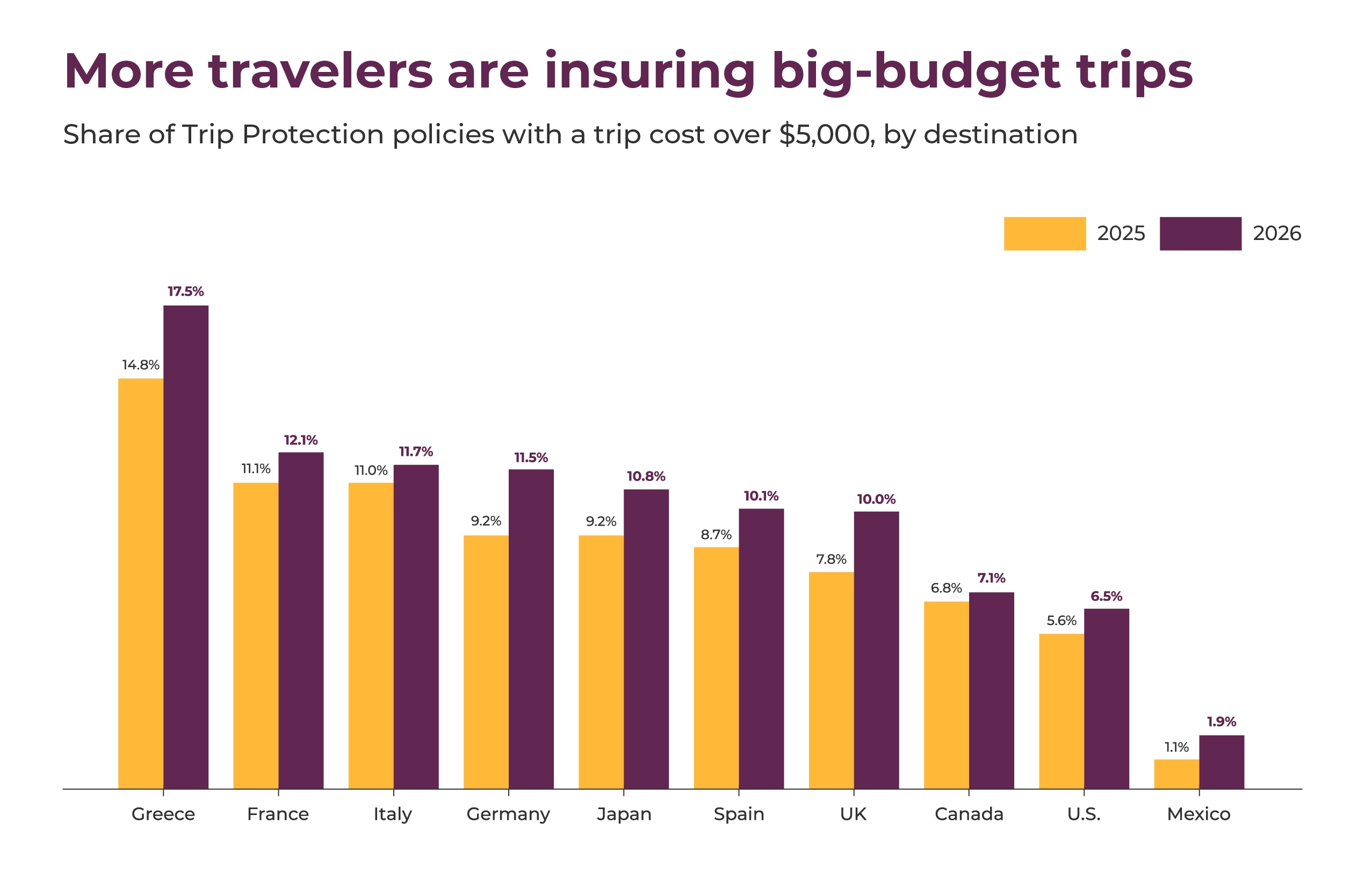
About 1 in 6 trips to Greece cost more than $5,000, the highest share of any top destination.
That's up from about 1 in 7 in 2025, and well ahead of France (12%) and Italy (12%), the next closest. Greece is also the only country in our Trip Protection top 10 that doesn't appear in the Travel Medical top 10. For many travelers, Greece is the big trip where protecting costs is top priority.
Greece isn't the only place where budgets are growing. High-cost trips gained ground in every one of our top 10 destinations, with Germany and the United Kingdom climbing fastest after Greece.
The share of Mexico trips costing more than $5,000 nearly doubled in 2026, from 1.1% to 1.9% of policies.
Mexico is still our #3 destination for both plan types, and most trips there remain modestly priced. But the high end is growing quickly. Trips over $20,000 barely registered in 2025 and now show up in our data, and the share of trips costing $10,000 to $20,000 more than doubled.
Interestingly, Mexico's share of Trip Protection policies dipped slightly. Fewer travelers may be heading there, but the ones who go are spending more. Mexico is moving well beyond the budget beach getaway.
The Seven Corners Trip Protection Annual Multi-Trip plan is up 187% year over year as more frequent leisure travelers choose them for convenience, value, and year-round coverage. For travelers taking multiple trips, annual plans can be simpler and more cost-effective than buying separate coverage each time, with added flexibility and streamlined protection.
Not exactly. In our data, the average trip length held steady in 2026: 16 days for Trip Protection travelers and 22 days for Travel Medical travelers. What we're seeing instead is travel heading in two directions at once.
Many travelers asked our agents about annual plans that cover multiple trips in a year, especially recent retirees and frequent cruisers. Some were planning back-to-back trips without returning home in between. Short getaways were common too, from road trips to Canada to visit family and friends to trips to seasonal and second homes.
At the other end, some travelers are staying put much longer. Our agents heard from people planning trips of four to five months or planning year-long stays abroad. River cruises through Europe were a favorite way to slow down too. Longer stays leave more room for cultural immersion: time to settle into a place instead of rushing through it.
If you'll take several trips in 2027, an annual plan may cost less than buying a plan for each trip. If you're planning a long trip, check a plan's trip-length limits before you buy.
More than 1 in 5 Trip Protection travelers in 2026 were 71 or older, our fastest-growing age group.
Travelers 71 and up made up 21.7% of Trip Protection policies in 2026, up from 19.5% in 2025. The 81-plus group grew about 21% on its own. We saw the same pattern among Travel Medical travelers, where those 65 and older rose from 14.9% to 16.5% of policies. Meanwhile, Travel Medical travelers in their 30s saw the biggest decline.
Our agents saw this firsthand. Recently retired travelers reached out asking about annual plans so they could take several trips without buying a new plan each time. Multigenerational trips were popular too.
Pre-existing conditions and emergency medical evacuation were also among the most common coverage questions our agents fielded all year. Learn more about what is considered a pre-existing condition in travel insurance and what to do if you get sick or injured abroad.
In 2026, the average traveler bought Trip Protection 75 days before departure, almost a week earlier than in 2025.
That fits with everything else in our data. Bigger, more expensive trips take more planning, and travelers are locking in their plans earlier. Some are thinking even further ahead. Throughout the year, our agents heard from travelers asking about coverage for trips more than two years away.
Buying early can make a difference. Some Trip Protection benefits, like a pre-existing condition waiver or Cancel For Any Reason, are only available if you buy your plan within a set number of days after your first trip payment. And Trip Cancellation coverage begins when your plan starts, not when you leave. The sooner you're covered, the more of your trip's planning period is protected.
AI is making travel planning remarkably convenient, helping travelers compare destinations, map out itineraries, and surface ideas in minutes. But convenience isn't the same as confidence. When accuracy, nuance, and on-the-ground context matter, many people don't trust AI-generated travel content on its own.
Instead, travelers are treating AI as a first draft. They're turning to travel advisors, local guides, and journalists who've actually been there to verify recommendations and fill in what an algorithm can't. That preference for real human expertise is exactly what sets Seven Corners apart. Our in-house team is there from quote to claim, and for every emergency in between. It's also why services like Seven Corners Assist matter more than ever: when something goes wrong abroad, travelers want a real person on the line.
Seven Corners agents have seen the shift firsthand. In 2026, more travelers mentioned using tools like ChatGPT to research their trips and their coverage options.
The catch is that AI doesn't always have current information. Some travelers asked our agents for plans an AI tool had recommended, only to learn those plans had been discontinued. Others arrived with unusual coverage scenarios an AI tool had described, looking for written confirmation of whether they'd actually be covered.
Our take? Use these tools to brainstorm, but when it comes to the details of your coverage, skip the AI agent and speak with a licensed Seven Corners agent instead. They'll give you a straight answer, no matter how confident ChatGPT may seem.
Global instability was travelers' top concern every month. In order of how often they came up with our agents, travelers' biggest worries were global instability, airline disruptions, travel advisories, disease outbreaks, and severe weather.
Those worries also led to the most common coverage questions, like whether a travel advisory or fuel shortage counts as a reason to cancel, how pre-existing conditions are covered, and how medical evacuation works. If any of those are on your mind, check out our blog and FAQs, read your plan documents closely, and ask a licensed agent before you buy.
2026 brought global instability, airline disruptions, and severe weather, and 2027 will likely bring more of the same. But our data shows travelers aren't letting that stop them. They're taking bigger trips, balancing splurges with short getaways, planning further ahead, and exploring well into retirement.
Whether you're dreaming of the Greek islands, a safari in Kenya, or your first trip as a retiree, the wonders and corners of the world are out there. And with a little planning, you can see them with confidence, with Seven Corners by your side.
Planning a 2027 trip? Get a quote today at sevencorners.com.
Did you enjoy this blog? Get more articles like it before anyone else when you subscribe to our monthly newsletter, The Wayfinder.
This website and various social media updates provided by Seven Corners contain content, information, articles, videos, and links to websites created by third parties. Seven Corners, its owners, and its employees neither endorse nor are responsible for the accuracy, timeliness, or reliability of any third-party information, statements, opinions, or advice and are not liable for any loss, harm, or damage caused by your reliance upon them. Use of such information or the linked websites is entirely at your risk. Concerns regarding this third-party content should be directed to the third party. Seek professional advice, as appropriate, regarding your use of such information and websites.
Because the information on this website and in Seven Corners’ blogs and other social media is written and compiled using knowledge and information available at a certain point in time, it may become outdated. For that reason, information, events, legal requirements, and product changes (including benefits, limitations, exclusions, and services) may not be up-to-date, complete, or accurate at the point in time it is being read. Again, use of such information is at your risk.